
In today’s digital world, customers search online before stepping into a store, calling a service provider, or booking an appointment. Yet, many local businesses in San Diego and beyond still rely only on word-of-mouth or social media pages. The truth is, if you don’t have a website, you’re invisible to a huge portion of potential customers.
1. Customers Search Online First
Shoppers still love Main Street, but they start their journey on Google. Most people who perform a nearby search tend to visit a business within a day. Without a website, you won’t appear on that digital map, and every invisible hour costs real revenue.
A branded website also protects you from algorithm changes on social media platforms you don’t control. Own your content, own your customer data, and you won’t panic when a new trend tanks your organic reach.
Trust grows, too. A polished URL and professional email reassure visitors that you’re legitimate and reachable. Pair that with local reviews, and you’ll turn online browsers into in-store buyers.
What a website brings to the table:
- An always-open storefront that answers questions 24/7: Your website works around the clock, providing information even when you’re off the clock. This builds convenience for customers and captures leads at any hour.
- Direct control over messaging, pricing, and promotions: You decide how your brand appears and what offers are front and center. There is no waiting on social media algorithms or ad approval.
- Built-in trust signals like SSL certificates and structured reviews: Security features and transparent feedback show visitors you’re legitimate. These cues make people more likely to choose you over a competitor.
- Easier lead collection through forms, calls, and chat widgets: Visitors can contact you instantly without digging for information. These tools help turn interest into action.
- A foundation for advanced tactics like local keyword research and paid ads: A website gives you a place to direct traffic from SEO and ad campaigns. It also lets you test and track what’s working over time.
Despite all this, a Brightlocal survey of SMB owners and decision makers found that only 40% of SMBs said they have a dedicated website.
Whether someone is looking for a plumber, restaurant, or boutique, the first step is almost always a Google search. If your business doesn’t appear in search results, chances are they’ll choose a competitor who does.
2. Builds Trust and Credibility
Every winning site starts with clear goals. Do you want calls, bookings, foot traffic, or all three? Write them down and tie each to a measurable metric such as form submissions per month.
Next, study your audience. Location, pain points, and search habits matter more than age or income brackets. Use social listening, customer interviews, and Google’s “People Also Ask” box to gather language your prospects actually use.
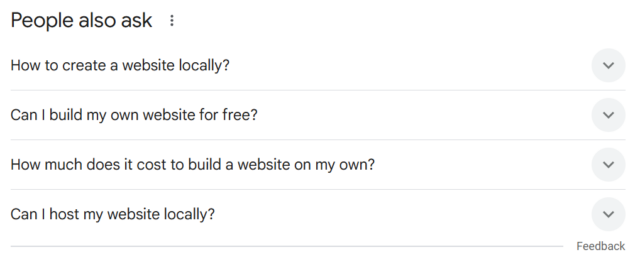
If this is your first local business website, don’t let this step be a blocker. Putting a simple one-pager together is a good starting point. Planning the rest of your site using the above data can come later.
Third, audit the competition. Note design cues, service gaps, and content angles you can beat. A simple spreadsheet tracking site speed, on-page SEO, and review count of your competitors can help reveal quick wins.
Do these first to set your local business site up for success:
- Define one primary goal and two secondary goals: Decide what your site should achieve, whether that’s more calls, bookings, or foot traffic. Prioritize one main goal, then add two backups to support it.
- Build a list of five core customer problems: Identify the top issues your customers face that your service solves. These problems should guide your messaging, content, and calls to action (CTAs).
- Compare three rival sites for content depth and load time: Analyze how competitors structure their pages, what content they include, and how fast their sites load. Look for gaps you can fill or areas where you can do better.
- Gather 20 seed keywords for Pages and FAQs: Use tools like Answer the Public or AlsoAsked to find common search phrases. These keywords will shape your content strategy and improve search visibility.
- Decide on a tone to keep branding consistent: Your tone helps create a connection and sets the mood for your content. Is your brand friendly, authoritative, professional or playful? Choose one that best fits your business and your audience, and stick with it across all pages.
When these foundations are solid, choosing domains, hosting, and platforms becomes much easier.
A professional local business website makes your business look legitimate. People are more likely to trust a company with a clean, updated site than one that only has a Facebook page or no online presence at all.
3. Works 24/7 for Your Local Business
Your website is always online, even when your shop is closed. It can answer questions, display your services, showcase reviews, and even take bookings or orders. This means you’re never missing opportunities.
4. Local SEO Brings More Customers
With the right SEO strategy, your website can rank on Google for local searches like “San Diego plumber” or “best tacos near me.” A website is the foundation for all your digital marketing efforts, including Google Maps rankings, ads, and reviews.
5. Showcases Your Services & Story
A website lets you highlight what makes your business unique. Whether it’s photos of your work, testimonials, or a clear breakdown of your services, you’re in control of how people see your brand online.
6. Competes with Bigger Brands
Even small local businesses can compete with larger companies when they have a strong online presence. With a well-optimized website, you can appear right next to national brands in search results.
7. Supports All Your Marketing Efforts
Every marketing campaign you run — social media, Google Ads, flyers — works better when it drives people back to a website. It’s your digital hub, where customers can learn more and take action.
8.Website Structure 101 (with Local SEO in Mind)
Search engines crave clarity. You need to give them a logical hierarchy that mirrors user intent. Typical local website structures start with a homepage, service pages, and a contact page, then expand into location or service-area pages where relevant.
Remember, laying it out in a clear, logical way isn’t just for the bots crawling your website. If your website is easier to use, it’s easier for someone to convert.

Once you’re set on a structure use clean, keyword-rich URLs.
For instance, “/plumbing-repairs-knoxville” beats “/page-id-12” every time. For both humans and Google’s crawlers.
Stick to a flat architecture, and aim for no more than three clicks from homepage to your deepest page, for easier crawling and less confusion.
Once you start building out a larger site, remember internal links to guide users from high-traffic content to service pages. Use descriptive anchor text like “emergency AC repair” instead of “learn more.” This signals topical relevance and helps boost engagement.
Start with these core pages to build a strong site structure:
- A homepage with your unique value proposition and primary call-to-action
- Service pages optimized around a single intent (think ‘air conditioning repair in santa monica’)
- Location pages for each office or branch (even if you only have one, a page with all your location details is important)
- An ‘About’ page featuring local team members and community involvement
- A contact page with dynamic map, phone link, and opening hours
When you map your structure early, you avoid messy navigation and empower both users and crawlers.
Conclusion
If you’re a local business in San Diego without a website, you’re missing out on customers every single day. A website isn’t just a nice-to-have — it’s a must-have in 2025. The good news? Getting started is easier and more affordable than ever.
Ready to put your business online? At SDO Digital, we build professional, SEO-friendly websites for local businesses that want to grow. Contact us today to get started.